




Extensive Range
Choose from our huge range of loose leaf teas, carefully selected from around the world
Up to 30% Bulk Discounts
Save up to 30% when you order multiple items. More information
Freshly Packed to Order
Our teas are carefully packed to order to preserve aroma, freshness, and flavour
Sourced from the beautiful Wuyi Mountain region of China's Fujian Province, this fine black tea has a distinct smoky aroma and taste, created from methods used during the drying process. Leaves are dried over pine wood fires to develop complex woody notes, complementing their natural flavours, and resulting in a delicious, well-balanced and robust tea. Lapsang Souchong can be served on its own, with lemon, or milk and sugar to taste.
Want to learn more about Lapsang Souchong? Read our article Lapsang Souchong Tea - Smoky, Rich and Unique.
Ingredients
Southern Black China Tea
Allergens
While we try to keep to the strictest standards in our treatment of allergens, please be aware that our factory handles nuts, milk and soy ingredients. Please check our ingredients lists for specific information on each tea.
Your Guide to Lapsang Souchong Tea
Lapsang Souchong is a luxury black tea from China known for its distinctive smoky flavour and aroma. It has been around for hundreds of years and is one of the most popular black teas in the world.
Its name is derived from lapsang, meaning smoky, and souchong, referring to the older, larger leaves that grow two or three leaves down from the bud and smaller pekoe leaves of the tea plant.
Lapsang Souchong tea leaves come from the same plant, Camellia sinensis, as other black teas, but are processed differently, being dried over pine wood fires to achieve their unique characteristics. Its smoky taste and aroma are derived from chemical compounds released when pine wood is burned.
Sections
- The History of Lapsang Souchong Tea
- How Lapsang Souchong is Produced
- Types of Lapsang Souchong Tea
- Reviews of Lapsang Souchong
- FAQs
The History of Lapsang Souchong Tea
There are different stories about how this smoke-dried Chinese black tea first came about, but the general belief is that Lapsang Souchong was created more by accident than design.
The story most often told is that during the Qing Dynasty, a passing army set up camp in an area of the Wuyi Mountains of China’s Fujian Province, where oolong tea was being produced. Its arrival caused such disruption that it delayed the leaf drying process and risked the crop being ruined. To speed up the process, the tea workers dried the leaves over pine wood fires, causing them to become darker in appearance and take on an intense smoky scent and taste.
The new flavour was liked by the Dutch tea traders who had been supplying oolong tea to Europe, and the smoking process became part of production. Lapsang Souchong became popular in Britain in the 17th century, partly due to Catherine of Braganza, the Portuguese wife of Charles II, who introduced the custom of drinking tea in the English court and is said to have loved Lapsang Souchong tea. It has also been said to have been a favourite of Sir Winston Churchill.
When it was first imported to Europe, Lapsang Souchong was used for medical purposes and sold in pharmacies. Like many teas, it contains antioxidants, vitamins and minerals. It also contains theanine, an amino acid known for its relaxing and stress-reducing effects.
How Lapsang Souchong is Produced
Tea leaves used to make Lapsang Souchong are plucked by hand and usually harvested in early May. The larger, older leaves chosen are coarser in texture and more suited to absorbing the smokiness from the pine wood.
The leaves are withered either outside in the sun or in a heating room, laid out on bamboo matting placed on slatted racks, with pine wood fires burning beneath them. A rolling process then helps release the oils in the leaves and starts oxidation. After several hours of oxidation, the leaves are pan-fired and then rolled a second time to extract residual moisture.
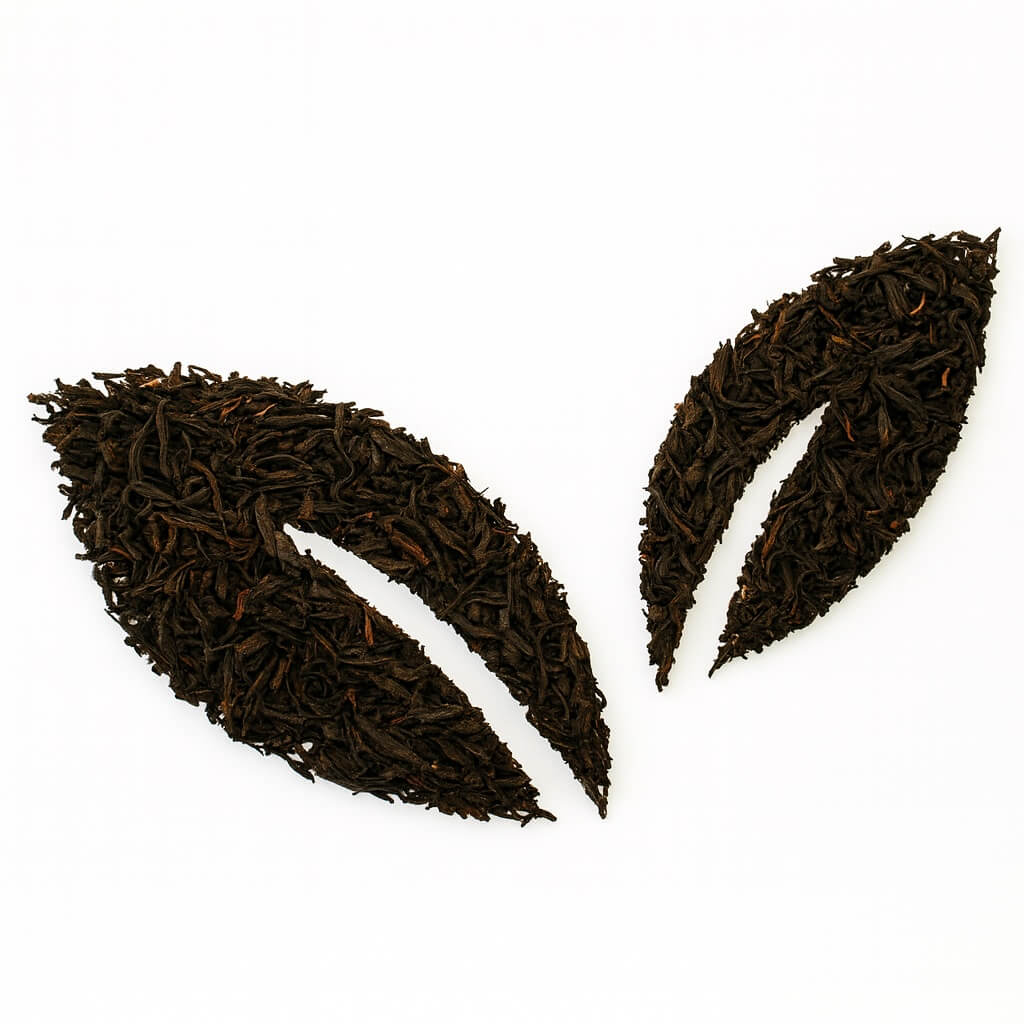
They are then dried in bamboo sieves over smouldering pine wood fires. Dried Lapsang Souchong tea leaves are typically quite large, dark, long and twisted, and glossy in appearance.
There is less caffeine in this tea than in many other black tea varieties. Although it is classed as a black tea, in China Lapsang Souchong is known as a red tea because the liquor it produces when infused is amber red in colour.
Types of Lapsang Souchong Tea
Lapsang Souchong tea may also be known as Zheng Shan Xiao Zhong, Smoky Souchong or Tarry Souchong. Although it originates from China and is mainly produced there, different varieties are now produced in other countries.
Taiwanese Lapsang Souchong is likely to have more pungent smoky or tarry characteristics than Chinese Lapsang Souchong because of a different smoking process. Formosa Lapsang Souchong Tea is one such example.
Lapsang Souchong also works well in tea blends, such as Russian Caravan Tea, a blend named after the camel caravans that once traversed the Ancient Tea Horse Road on long journeys transporting tea from China to Europe, during which the tea absorbed smoke from campfires.
Reviews of Lapsang Souchong
Here’s what some customers are saying about the unique characteristics of Lapsang Souchong teas.
Lapsang Souchong Tea
Sourced from the Wuyi Mountain region of China’s Fujian Province, Lapsang Souchong is a fine black tea with a distinctive smoky aroma and flavour, and complex woody notes. Robust and well-balanced, it is perfect served on its own, with lemon, or with milk and sugar if desired.
“My favourite smoky tea - lovely large leaves.”
“My favourite tea to have for cream tea. Rich, deep flavour and exceptional quality. Smokey, but not burnt. First class.”
“Excellent smoky flavour, great quality tea with obvious leaves. Brews to make a beautiful tea with a lovely taste.”
“Large leaves of delicious, delicate smokey tea - in a large quantity. What's not to love?”
“Great Lapsang. Decent size leaves, lovely smoky flavour. I’ve been to Wuyishan to get Lapsang direct from the source before, but the language barrier was tricky, and now I don’t need to.”
“Excellent taste, colour, and bouquet. The smell of smoke makes me think of wood cabins, open log fires, and kippers for breakfast. A refreshing brew that I drink at mindful moments. If you like smoked food I'd recommend you try this tea without hesitation.”
Lapsang Souchong Butterfly Tea
Another luxury black tea from China’s Fujian Province, Lapsang Souchong Butterfly Tea is grown at high altitudes in mountain and evergreen forest areas that provide the ideal climate for producing top-quality tea leaves. When dried over wood fires, the leaves reveal aromas of pine and oak, and smooth, crisp, smoky flavours.
“Lovely flavour.”
Formosa Lapsang Souchong
Grown in Nantou County, Taiwan, Formosa Lapsang Souchong is stronger than the Chinese variety of this distinctive flavoured black tea due to a different smoking method being used. It has the traditional smoky taste but with more earthy characteristics, and is thought to have both energising and relaxing effects.
“I have been drinking a variety of Lapsang Souchong teas for many years and some are too bold and others far too mild. This one is delicate but with the right amount of smokiness. An excellent tea.”
FAQs
What does Lapsang Souchong taste like?
Lapsang Souchong is a bold, distinctive tea that may not be to everyone’s taste. It can be an acquired taste, but those who enjoy smoky flavours, wood smoke aromas and piney notes are likely to appreciate it.
It has also been described as having flavours reminiscent of dried longan, peaty whisky and smoked paprika. These smoky characteristics make Lapsang Souchong a useful ingredient in cooking as well, where it can be used as a dry rub for meat and fish or as a flavouring in sauces, stews and casseroles.
How should I prepare Lapsang Souchong loose leaf tea?
As with other black teas, Lapsang Souchong should be prepared using freshly boiled water, with filtered tap water or bottled spring water often giving the best results.
Use one teaspoon of loose-leaf tea for every 230 ml of water and steep the leaves for 2 to 5 minutes at around 95°C. The leaves can be steeped more than once without becoming bitter.
Lapsang Souchong is traditionally served on its own, but milk and sugar can be added if desired. It can also be enjoyed as an iced tea or cold brew, and works well in cocktails, particularly those containing whisky.
Where can I buy the best Lapsang Souchong tea?
If you’re looking for high-quality Lapsang Souchong loose tea, there are excellent China Lapsang Souchong and Formosa Lapsang Souchong varieties available for those who enjoy rich smoky tea flavours.
We deliver across the UK and to selected EU countries using Royal Mail. Available delivery options and charges are shown at checkout. Our standard delivery service takes 1–2 working days.
Some third-party supplied products may have different delivery times and costs, which will be clearly shown at checkout.
Some equipment may be shipped directly from the manufacturer. Where this applies, full delivery details will be provided at checkout.
All of our teas remain fresh unopened for up to 12 months.